Discovery
Bye-bye algorithms
There is no feed here. Fans arrive because they went looking, or because somebody sent them — and the audio comes straight off your machine.
The absence
What isn't here, on purpose
No recommendation engine. No browse page. No directory. No charts, no front page, nothing queued up after the record you chose.
These aren't features we haven't got to yet. They're not on the roadmap and they're not coming.
Streaming platforms didn't only take over hosting, distribution and payment. They took over discovery and curation too — and once one company does all of it, there's very little room left for anybody else to matter.
Station isn't trying to replace that model with a better-behaved version of the same thing. It's trying to break it apart and hand the pieces back.
The mechanism
How a fan reaches your music
Four steps, and only the first one involves anything you'd call discovery.
-
A fan searches your namespace
They type the handle you claimed. No browse page led them here — they came looking, or somebody sent them.
-
The network resolves it to your node
Your server announced that name when you saved it: this name belongs to this node, and here is where to reach it. Other nodes remember.
-
Your catalog loads from your server
Covers, titles, track listings, prices — read straight off the machine you are paying for.
-
Play streams the audio directly
Your server to their browser. The audio does not pass through us, or through anybody else.
Your handle
The namespace is the whole address book
Your namespace is what fans type to find you. Imagine two bands called The Chips — one
holds thechips, the other thechipsog. Names are claimed first come, first served.
When you save it, your node announces it to the rest of the network. There's no registry company, no renewal invoice, and nobody who can reassign it. Once it's claimed and confirmed it's permanent — so choose carefully.
beta.qnch.network/artist/your-namespace A link works whether or not the person opening it has ever heard of qnch. That's the other half of discovery: you send it, a blog embeds it, a friend forwards it.
The trade
Your node is your availability
If your server is off, your music is unavailable. Not deleted — unavailable.
Nobody else holds a copy. While your node is down, fans can't stream, buy, or download from you. When it comes back, everything resumes exactly where it was.
That's the trade for owning your distribution outright: no one can take your music down, and no one can keep it up for you either.
It's also the practical argument for a cheap VPS that stays on over a laptop that goes to sleep. Uptime is now a thing you own.
Room left over
The empty space is the point
Reviewers, critics, DJs, curators, blogs, record shops, magazines, and one person sending another person a link. There's little room for any of them when a platform does everything, and the space Station leaves empty is exactly the space they work in.
Leaving it empty is what lets those people operate as themselves rather than as inputs to somebody's ranking model. We're not competing with the essential parts of music culture. We just stopped absorbing them.
The listener app
What your fans actually use
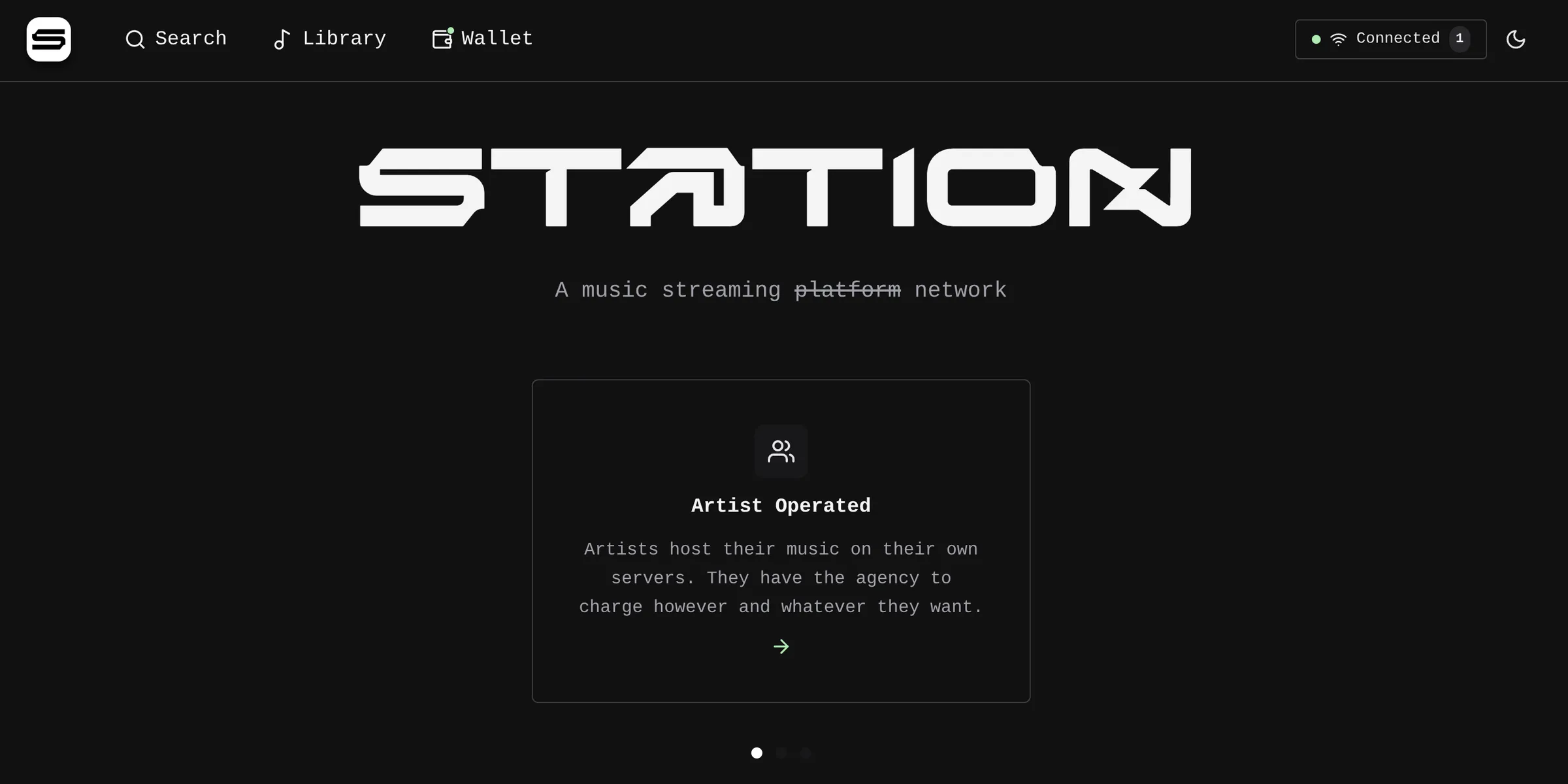
A web app at beta.qnch.network. Nothing to install, works in any browser.
Fans can stream your music, buy a track or an album, rent an album for a window if you've enabled it, mint a FanPin to join your fan club, download anything they've bought, and follow you — with their follows and saved albums kept in their own browser.
When a fan needs a wallet
Nothing gets in the way of listening to music you've made public. A wallet only appears when money or fan-only access does.
When you gate music to a FanPin generation, your node checks which generations the fan's wallet holds and serves the audio only if their FanPin opens that door. Access is per generation, not a blanket pass — holding any FanPin doesn't unlock everything. That's what lets early membership mean something.